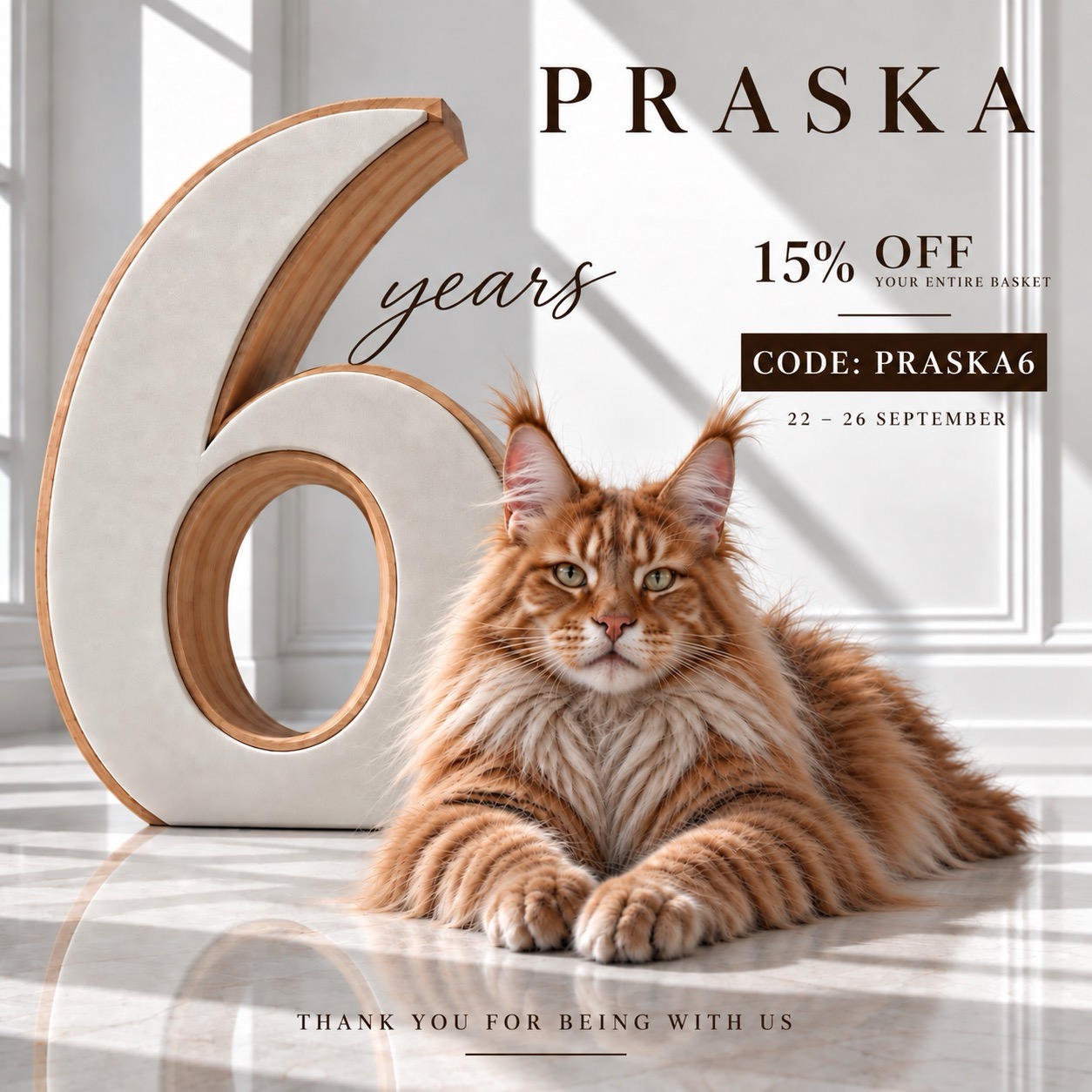
How to design space for a Maine Coon and other large breeds
A Maine Coon can reach up to 120 cm in length (nose to tail tip) and weighs 8-10 kg. Not every scratcher, shelf or bed can take the load of a cat this size - especially the dynamic load of a jump. In more than 14 years of breeding Maine Coons, I've learned that dimensions, load capacity and construction stability are exactly what decide whether a cat will want to use a piece of furniture every day.
Why don't standard cat products work for a large cat?
Most cat furniture on the market is designed for animals weighing 4-5 kg. A Maine Coon is longer, heavier and stronger. A Ragdoll weighs 6-9 kg. A Norwegian Forest Cat, 5-9 kg. A Savannah, depending on generation, can weigh over 11 kg.
For all these breeds, standard dimensions for beds, shelves and dens are too small. A cat that doesn't fit comfortably in a bed, or has to squeeze into a den, will simply stop using it.
The experience I've gained from watching Maine Coons every day has let me create products that meet the needs of all large breeds - not just for durability, but above all for dimensions.
A shelf's load capacity isn't the same as a cat's weight
I often hear the question: why does a shelf need a 50 kg load capacity when the cat only weighs 9 kg? The answer is simple. A cat doesn't sit down gently. It jumps. Landing on a shelf generates force many times greater than the cat's own body weight.
A structure with little margin for strength will flex, wobble or creak. And a cat won't put up with unstable structures. If a shelf flexes under a jump, the cat gives up on it - and doesn't come back. It chooses a wardrobe, a windowsill, or somewhere else that gives it confidence.
Once correctly mounted, our wall shelves for cats shouldn't flex or make noise even under everyday use by Maine Coons. That's why we design them with a generous margin of strength - not for the spec sheet, but for real dynamic loads.
Why do furniture dimensions matter down to the centimetre?
This is one of the questions I hear most often: will this den or shelf work for a Maine Coon?
What matters is a bed's diameter (can the cat fit comfortably and change position), a shelf's length (can the cat stretch out to its full length on it), and a den's entrance size (can a Maine Coon get inside without squeezing through).
That's why at PRASKA we design beds with larger diameters, and shelves and platforms sized for large breeds. Dens for large cats have bigger entrances and more space inside than standard models.
How does a large cat use vertical space?
Maine Coons like height. But the route up needs to be safe and comfortable - especially with a body weight over 8 kg, where slipping on a smooth surface can end in a fall.
Wall scratchers with trees give large cats what they need: a stable climbing surface, the chance to scratch vertically, and a lookout point up high. Felt on shelves and platforms gives grip - paws don't slip while climbing up, landing after a jump, or during play.
Vertical space matters especially in smaller flats. Instead of taking up floor space with another standing scratcher, a system of wall shelves, trees and play areas makes use of wall height instead. A Maine Coon in a flat can have a full climbing, scratching and resting space - without taking up room from the people living there.
How does PRASKA test furniture for large breeds?
Every new product goes to my own cattery first. We then send it to other catteries where Maine Coons and other large breeds live. There, for several weeks - often even a month or two - it's used intensively in everyday life.
Breeders send us specific feedback: does the cat use the product willingly, does it come back to it every day, does it have enough room, does the construction stay stable after weeks of use. We use this to make adjustments - sometimes changing a platform's dimensions, sometimes widening a den's entrance.
Only once testing is complete and adjustments have been made does a product go on sale. That means we're not offering prototypes - we're offering solutions proven by breeders and their cats.
Every PRASKA product starts from one simple idea - the cat's needs come first, the design comes after. That's exactly why breeders and owners of large cats in so many countries choose our furniture.
Izabela Praska
Pedigree cat breeder and founder of PRASKA
Frequently asked questions
What furniture should I choose for a large cat?
A large cat needs stable structures, larger beds, and shelves and platforms with the right dimensions. They should allow a cat to stretch out fully, change position, and move around safely.
Is furniture for a Maine Coon different from standard furniture?
Yes. A Maine Coon is considerably larger and heavier than most house cats. Furniture should have a larger surface area, appropriate load capacity, and stable construction.
Why does a shelf's load capacity matter so much?
Jumping onto a shelf generates far more force than the cat's weight alone. That's why the construction needs a solid margin of strength, especially for large breeds.
Are PRASKA products tested with Maine Coons?
Yes. Every new model goes through weeks of testing in my own cattery and in other pedigree catteries. Only once testing is complete and adjustments made does it go on sale.


 Log in with Facebook
 Log in with Google